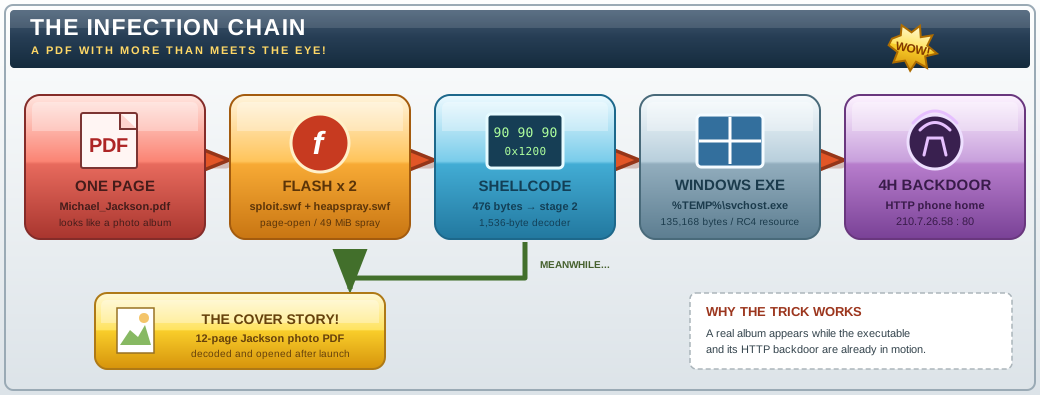
Every so often, a sample comes along that makes us do a double take.
Michael_Jackson.pdf is one of them. Its name suggests the
photo collections making the rounds this summer. But behind a
single-page wrapper is a miniature attack kit: two Flash movies, a
hidden Windows executable, an encrypted 4H backdoor, and, for good
measure, a twelve-page Jackson photo album ready to pop up as the cover
story. That is quite a lot of trouble packed into a document that
appears to offer pictures! It is precisely the sort of layered lure that
should make anyone tracking advanced persistent threats (APTs) sit up
and take notice.
We examined the 1,370,410-byte attachment without opening it in Adobe
Reader or running its embedded code. Its MD5 is
c81b78bd53249c0944cdf5d3b24e736c and SHA-1 is
8275783aacfc6fc4757f0b847202989401c29fd7. We have no
evidence of the message or website that delivered this particular
copy.
A photo album with a hidden first page
The outer document claims to have a single page. Its page-content
stream is peculiar: the dictionary says the stream is 120 bytes long and
Flate-compressed, yet more than 1.3 million bytes appear before
endstream. Carving those bytes reveals a second PDF encoded
with a simple XOR value of 0xFE. Decoded, it is a
twelve-page, image-based photo retrospective, with 23 Jackson
photographs ranging from performances and childhood images to a
medical-chamber picture. The pictures are real lure content; the
shellcode is designed to save and open this photo PDF under the original
document name after it starts the malware.
Before that happens, the outer page asks Reader to activate two
embedded Flash objects as soon as the page receives focus. The PDF’s two
/RichMedia annotations point to sploit.swf and
heapspray.swf; both specify the /PO page-open
condition. The catalog also mentions JavaScript, but the referenced
object is empty. The attack logic resides in ActionScript, a useful
reminder that disabling PDF JavaScript alone does not remove the Flash
attack surface.
This construction is consistent with the recently disclosed CVE-2009-1862
flaw in Flash and the authplay.dll component included
with Adobe Reader and Acrobat 9.x. Adobe has reported targeted attacks
against Reader 9 on Windows. The precise memory-corruption instruction
in the tiny sploit.swf remains uncertain from static
inspection, so the CVE identification is based on the document’s
structure rather than on a reproduced crash.
From Flash to a Windows executable
The larger Flash movie does the preparation. Its ActionScript grows a
string to roughly one megabyte, fills a ByteArray to about
49 MiB with writeMultiByte, then places
476 bytes of x86 shellcode into the sprayed area.
Disassembly shows that this shellcode searches open file handles for its
own PDF, checks for a PdPD marker at offset
0x1200, and decodes a 1,536-byte second stage with a
four-byte XOR key.
The second stage knows where the rest of the payload is hidden. It is
written to decode a 135,168-byte PE32 executable from
the PDF, save it as %TEMP%\svchost.exe, and start it with
WinExec. It also extracts the Jackson photo album and
issues a command to open it. The order matters: the album is a plausible
explanation for the document the victim expected to see, while the new
executable is already being launched. These are code paths recovered by
disassembly, not behavior observed on an infected machine.
The svchost.exe file carries two more components in its
resources: a 49,152-byte loader and a 36,864-byte encrypted backdoor.
The loader derives a 128-bit RC4 key from the literal password
FG@55512 using MD5, then decrypts the backdoor. Its imports
include VirtualAllocEx, WriteProcessMemory,
SetThreadContext, and ResumeThread, suggesting
process manipulation during installation. The stage also refers to
msado30.exe and msado30.tlb beneath the Common
Files ADO directory, although we did not run it to establish the final
on-disk sequence.
The phone home
The recovered backdoor is a 4H variant. It assembles
210.7.26.58 byte by byte, places it in three server slots,
and assigns port 80 to each. Its WinINet code
constructs HTTP GET object names in the form
search5%d?h1=%d&h2=%d&h3=%s&h4=%s. The
parameters include an operating-system value, the fixed marker
ZIH14627, and an identifier derived from disk-volume
information. Other routines prepare HTTP POST traffic. Data sent and
received passes through a single-byte XOR operation with the value
0xBE.
There is also a separate GET to
www.google.com/search?qu= using a
Firefox/2.0.0.2 user agent. That request is a connectivity
check; Google is not the command server. The code’s
remaining imports and routines support a remote shell, process and file
listings, and enumeration of network shares. We confirmed the address
and protocol by reading the decrypted program, not by making a network
connection.
The clues left in the files
The photo album’s metadata is unexpectedly talkative. Its title is
文档 1 (“Document 1”), its author is yang, its
creator is pdfFactory Pro www.fineprint.cn, and its
producer reports Windows XP Professional Chinese. The album
records creation at 16:45:38 on July 30, 2009, with a
+08'00' time-zone offset. The one-page exploit wrapper
offers only a pyPdf producer label and no creation date.
None of the album’s 23 pictures retains EXIF or GPS data. The
+0800 clue belongs to the album and could have arrived with
a reused document.
The executable chain supplies another lead. Resource entries in the
extracted svchost.exe, its loader, and the decrypted 4H
backdoor all carry language ID 0x0804,
Windows’ tag for Simplified Chinese (China). Their PE header timestamps
run backdoor to loader to wrapper in 40- and 41-second steps on June 29,
2009. Those headers store no time zone; displaying the moments as a
China workday does not uncover a second +0800 marker. The
inner programs also claim Microsoft identities in their version strings,
including msado30.exe and
msimn.hlp—camouflage, not signed vendor provenance.
The China APT question
With the GhostNet investigation still fresh in investigators’ minds, the question nearly asks itself: could another China-linked APT operation be hiding behind a harmless-looking document? GhostNet showed how malicious attachments could reach high-value targets and give attackers remote control. This PDF presents the same kind of danger: a single opening could put a remote shell, file discovery, and network-share enumeration within an operator’s reach.
Those clues make the question worth asking, but they do not answer it. We have no delivery message, victim list, or operator identifiers for this sample. The command-server address was routed through a Fiji-linked network in 2009, so it supplies no China-location clue. The GhostNet researchers themselves cautioned that network location did not prove Chinese state direction. What this attachment shows with certainty is the danger of an APT-style foothold: the photo album can reassure the reader while a backdoor quietly takes its place.
The striking feature of this sample is its layering. A Flash movie reaches shellcode; shellcode finds data hidden in the PDF; that data becomes a Windows executable; an encrypted resource becomes a backdoor; and a Jackson photo album supplies the expected document. For defenders, the practical lesson is to treat embedded Flash in PDFs as executable content and to apply Adobe’s Reader, Acrobat, and Flash updates for CVE-2009-1862. The cover photographs should not be mistaken for evidence that the attachment was harmless.
Sample indicators: PDF MD5
c81b78bd53249c0944cdf5d3b24e736c; recovered
%TEMP%\svchost.exe MD5
1f01cc7ab51151c1221db3eb9a66ea1a; decrypted 4H backdoor MD5
42bbe57b8de6d5e549eac10c2dccef88; configured server
210.7.26.58:80; HTTP marker ZIH14627. No code
from the attachment was executed during this analysis.